
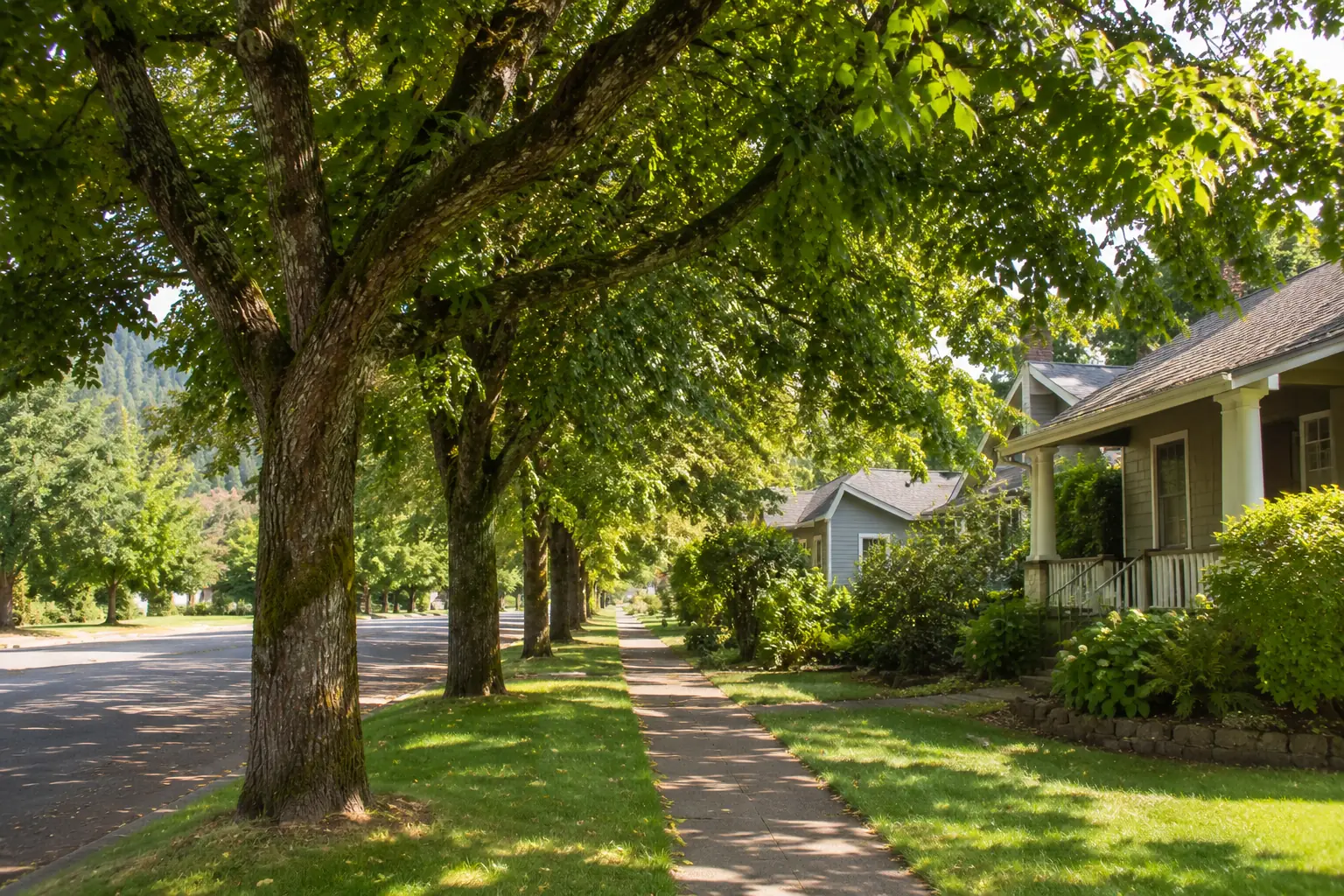
Inside Rogue River city limits, the rules most likely to affect tree removal are the street tree ordinance and the riparian rules along the Rogue River, Evans Creek and Wards Creek. Outside city limits, Jackson County's stream setbacks apply. Call (541) 507-9640 to reach a single tree company, CCB-licensed, and confirm approvals with the city or county first.
Is a city permit needed for a backyard tree in Rogue River?
For a yard inside Rogue River city limits, this is the plainest answer the sources on this page allow:
- A tree in the strip between the sidewalk and the street, or on ground that may be public. Check with City Hall ahead of any work. That ground is what the street tree ordinance covers.
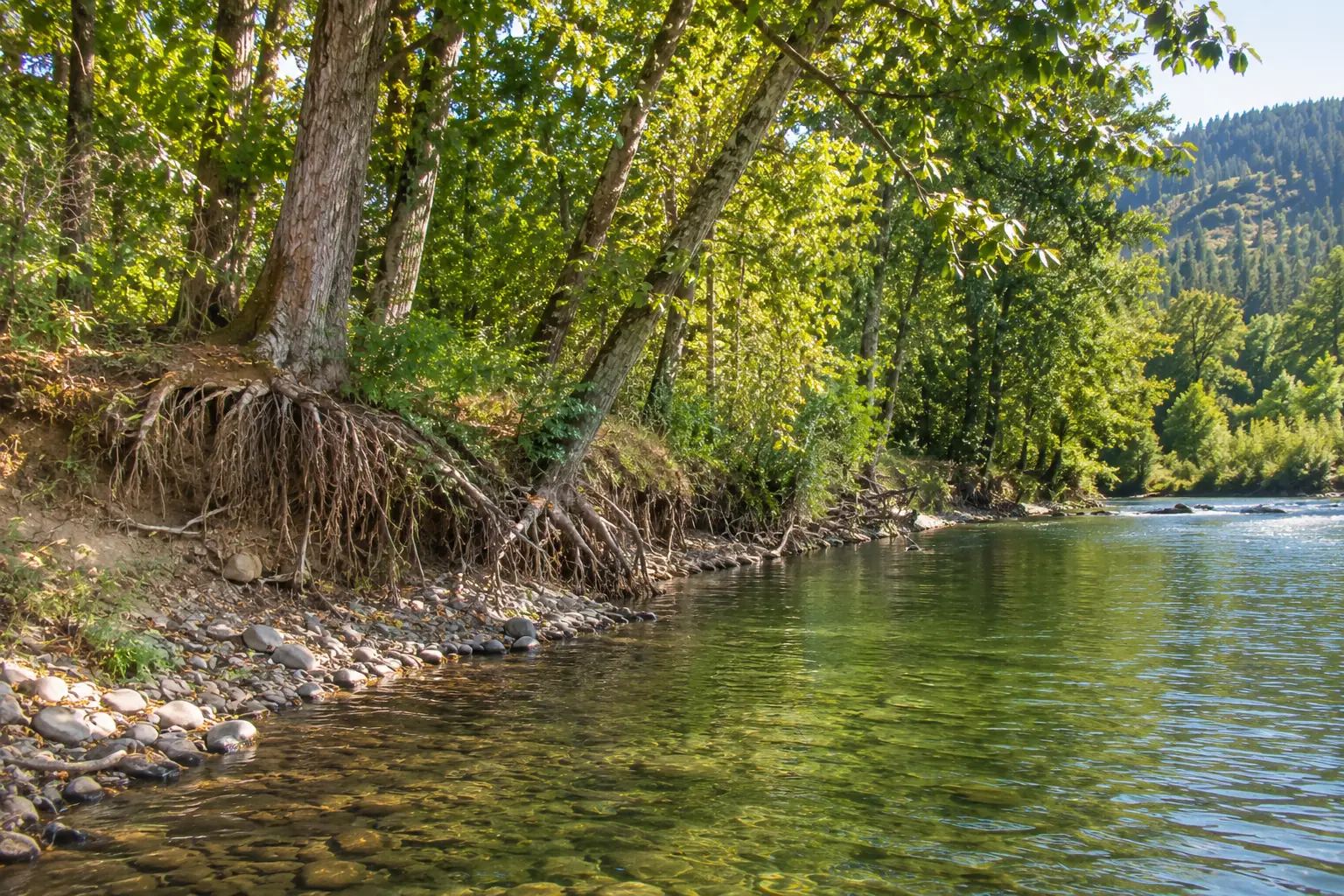
- A tree within 75 feet of the Rogue River, or 50 feet of Evans Creek or Wards Creek. Yes, city approval comes first, except in an emergency.
- A tree anywhere else on your own lot. No. The city's street tree ordinance (Chapter 12.20 of the municipal code, checked 28 November 2026) sets out permission only for trees in the parking strip and other public places, and it contains nothing that makes a homeowner get a permit to take down a tree standing in a private yard. It can still touch a yard tree in two ways: limbs over a street have to clear the sidewalk by eight feet, and the city may order a dead or diseased tree that endangers people or property to come down, with 30 days to do it once notice is served.
That answer comes from one chapter of the code. Zoning conditions on a particular lot, a subdivision's own rules or a newer ordinance could add something, so ring City Hall at (541) 582-4401 with your address before the saw starts.
Start with one question: city or county
Which rules apply depends first on whether the property is inside Rogue River city limits or in unincorporated Jackson County. A Rogue River mailing address does not settle it, because a mailing address and city limits are not the same thing.
Ways to find out:
- Check your property tax statement, which shows the taxing districts for the parcel.
- Call City Hall at (541) 582-4401, the number on the city's planning page, and give the address.
- Call Jackson County Development Services, Planning Division, at 541-774-6907, listed on the county's planning page.
Once you know, use the matching section below.
The city's street tree ordinance
The City of Rogue River has a street tree ordinance, Chapter 12.20 of the Rogue River Municipal Code. The city's municipal code page links to the full code, which is hosted online.
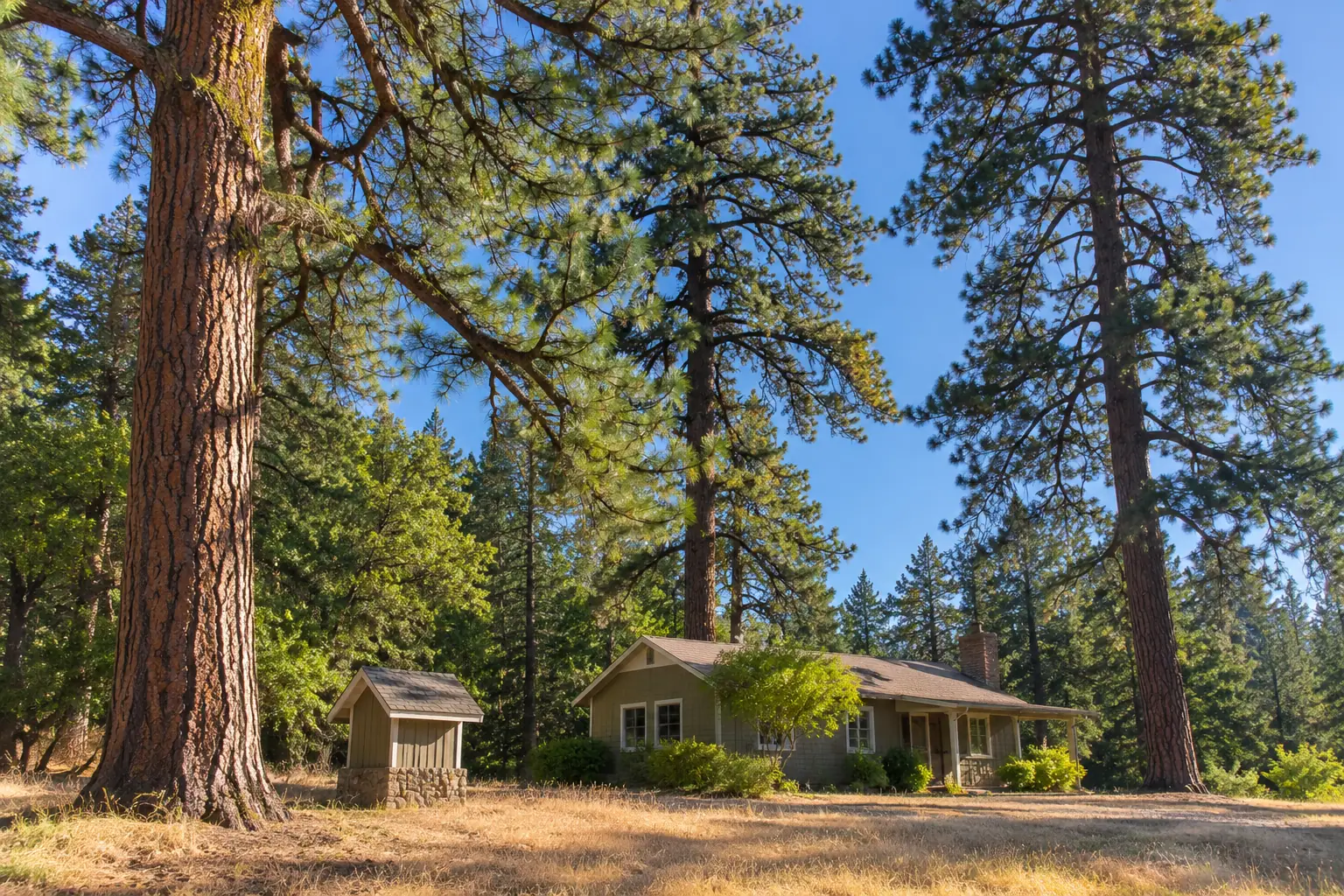
The chapter covers:
- Permission to plant trees in the street area.
- A Tree City committee and its duties.
- A list of acceptable species and spacing between trees.
- A section that declares dangerous trees a nuisance and gives the city summary powers to remove them.
The city has been a Tree City USA for more than 40 years, according to its home page. Its Tree City Committee is advisory. The city's boards and committees page says the committee advises the Public Works Director on tree maintenance, planting and education, and that it has no authority to sign contracts or hire contractors.
What this means for you: if the tree you want removed stands in the strip between the sidewalk and the street, or anywhere you are not sure is your own land, call City Hall before work starts. Read the current text of Chapter 12.20 for the exact steps, since this summary does not replace it.
The city's riparian rules
Along the Rogue River and the creeks that run through town, the city protects a strip of land called the riparian area. The city's riparian rules are in Chapter 17.135 of the municipal code. The Jackson Soil and Water Conservation District publishes a plain-language guide to the City of Rogue River riparian rules, which notes that the ordinance itself controls.
According to that guide:
| Waterway | Setback from top of bank |
|---|---|
| Rogue River | 75 feet |
| Streams, including Evans Creek and Wards Creek | 50 feet |
Inside those setbacks, the guide says:
- Vegetation must be kept by default, and clearing or thinning is not allowed without city approval.
- With city approval, owners can remove nonnative invasive plants such as Himalayan blackberry, remove hazardous or dangerous trees, and carry out approved restoration or landscaping.
- Removal requires native replanting, typically about one native tree or shrub per 64 square feet removed, plus erosion control.
- Hazard tree removal is allowed when the tree poses an obvious safety risk. City approval is required beforehand except in emergencies, and replacement with native species is generally required, typically at three to one.
- Herbicides, pesticides and fertilizers are generally prohibited unless approved.
The guide also lists the Oregon Department of State Lands and the Oregon Department of Fish and Wildlife among the agencies that may be involved. The riverbank tree removal guide covers banks, erosion and replanting in more detail.
Jackson County rules outside city limits
Outside city limits, the county rule most likely to touch a tree job is its riparian setback along rivers and streams. The Jackson Soil and Water Conservation District's Jackson County guide gives the same distances as the city: 75 feet from the top of the bank on the Rogue River and 50 feet on streams.
That guide says trees, shrubs and other vegetation inside the setback must be kept in place by default. It lists these among the things not allowed without prior approval:
- Removing healthy trees.
- Clearing riparian vegetation.
- Expanding lawns toward streams.
- Dumping yard debris or compost.
- Clearing for wildfire fuelbreaks.
- Placing soil, gravel or fill near streams.
It also states that wildfire fuelbreak requirements do not override riparian protections. Approvals come from Jackson County Development Services, and the county's riparian rules are part of its Land Development Ordinance. The Jackson Soil and Water Conservation District gives guidance only and does not issue permits.
Away from streams, the county sources checked for this guide do not show a general permit for removing a tree from private land. That does not mean none applies to your parcel. Zoning, recorded conditions on a land use approval, or a homeowners association can still limit cutting, so ask the county planning desk if you are unsure.
Forest land and log sales
If trees are cut and sold from forestland, the Oregon Department of Forestry may need to be notified first. ODF's notification page says you must notify the department at least 15 days before starting a forest operation, and that information about intent to harvest is shared with the Department of Revenue.
A single yard tree cut for safety is a different matter from a harvest on acreage. Ask ODF which one your project is before work begins. The rural acreage guide has more on larger properties.
Fire season limits on saws and machines
During fire season, the Oregon Department of Forestry limits when saws and engines can run on the lands it protects. The Southwest Oregon District's 2026 season began May 15, according to the ODF announcement reposted by Jackson County Fire District 3.
The district's 2026 regulated closure proclamation sets these power saw rules:
| Fire danger level | Power saw use |
|---|---|
| Low (green) | Any hour |
| Moderate (blue) | Until 1 p.m., then from 8 p.m. |
| High (yellow) | Until 10 a.m., then from 8 p.m. |
| Extreme (red) | Prohibited |
Each saw must have a shovel and an extinguisher rated eight ounces or larger, and an hour-long fire watch is required after each saw is used. Battery and electric chainsaws are included. Backyard debris burning is prohibited throughout fire season. ODF's fire restrictions page has maps of current public and industrial restrictions.
Trees near power lines
Work near overhead lines follows the utility's lead. Pacific Power's tree page tells customers never to prune limbs or remove trees near power lines, offers an evaluation by an arborist the utility sends out, and offers a free temporary disconnect of the service line to a home so licensed professionals can work safely. No rule on this page covers a tree that has landed across a line, or a wire lying in the yard. That is an emergency: 35 feet of distance, 911, and Pacific Power at 1-877-508-5088 once 911 has the details.
Licensing for tree companies
Oregon requires a license for paid tree work. The Construction Contractors Board lists tree servicing among the work that needs a license on its license page. The Landscape Contractors Board's tree work FAQ says either a CCB or an LCB license allows removing trees and grinding stumps, while planting trees requires an LCB license. That last point matters if your city or county approval calls for replanting.
Who to call
| Question | Who to call | Source |
|---|---|---|
| Street trees, city riparian approval | City of Rogue River, (541) 582-4401 | city planning page |
| County setbacks and approvals | Jackson County Planning Division, 541-774-6907 | county planning page |
| Plain-language riparian guidance | Jackson Soil and Water Conservation District, (541) 423-6159 | JSWCD guide |
| Fire season, saw hours, forest operations | ODF Medford Unit, (541) 664-3328 | ODF announcement |
| Trees near lines, not touching | Pacific Power, 1-888-221-7070 | Pacific Power trees |
| Downed lines, tree on a line | 911 first, then Pacific Power, 1-877-508-5088 | Pacific Power safety |
| Contractor license check | Oregon CCB | CCB license search |
Rules change. Confirm the current requirements with the city or county before any tree near water or in the street area is cut. For prices, see the tree removal cost guide. For a tree that needs attention now, see the hazard tree removal page. The home page lists every kind of tree job this line covers.
Frequently asked questions
Do I need a permit to cut down a tree in Rogue River?
In two places, ask the city first: the street area, which falls under the city's street tree ordinance, and ground lying within 75 feet of the Rogue River or 50 feet of Evans Creek or Wards Creek, where the riparian rules call for city approval. For a backyard tree clear of both, this guide lists no city permit, but that has not been confirmed with the city. Call City Hall at (541) 582-4401 to settle it for your lot.
How far from Evans Creek do the riparian rules reach?
The Jackson Soil and Water Conservation District's guide to the city rules gives 50 feet from the top of the bank for Evans Creek and Wards Creek. For the Rogue River itself, it gives 75 feet.
Can I clear trees near a creek for wildfire defensible space?
Not without approval. The district's Jackson County guide states that wildfire fuelbreak requirements do not override riparian protections. Ask the county or city what fire clearing they allow inside the setback.
Can I run a chainsaw during fire season?
On ODF-protected land, the 2026 Southwest Oregon proclamation allows saws at any hour when danger is low, in limited hours at moderate and high danger, and not at all at extreme danger. A shovel, an extinguisher and a one-hour fire watch are required.
Who decides where the top of the bank is?
The Jackson Soil and Water Conservation District's county building guide says top of bank generally means the upper edge of the streambank where the slope begins to level out, and that it is not always easy to identify. Ask the city or Jackson County planning staff to confirm it for your property before you measure a setback.